I Am My Own Worst Critic: Advice for Fluid Artists
I am my own worst critic.
There. I said it.
And after years of being a full-time artist, creating hundreds of paintings and reaching the point where collectors pay thousands of dollars for my original work, I can tell you that this inner critic hasn't magically disappeared.
I can finish a painting that so many people love and still immediately notice that one little area I wish I had done differently.
Why did I blow this part out so far?
Those cells looked so much better before I touched them.
Why did I add that color? It was better without it.
I should have stopped ten minutes earlier.
And then, if you let that voice keep going...
Maybe I'm not as good at this as I thought I was.
Maybe I'm just not a good artist.
Sound familiar?
Being critical of your own art isn't necessarily a bad thing. In fact, I believe a healthy amount of self-criticism is one of the reasons we improve as artists.
But there is an enormous difference between looking at your painting and thinking:
"What could I learn from this?"
and:
"I'm just not good enough."
One helps you grow.
The other slowly takes the joy out of creating.
And if you work with fluid art or acrylic pouring, where you can influence the paint but can never control every single movement, learning that distinction becomes especially important.
Your Inner Critic Isn't Always the Enemy
I don't think the goal should be to silence your inner critic completely.
I certainly haven't silenced mine.
That critical voice can actually be incredibly useful.
It has pushed me to learn new fluid techniques, improve my brushwork, develop embellishments, study composition more deeply, and become more intentional with my acrylic pouring process.
The problem isn't having high standards.
The problem is when those standards become so loud that you stop seeing everything that's already working.
Or when you keep moving them every time you reach them.
Congratulations. You've invented a game you can never win. 😄
I've caught myself doing this too.
So instead of trying to eliminate self-criticism, I've learned to manage it - and sometimes even use it to my advantage.
Here are a few things that have genuinely helped me.
1. Separate "I Don't Like This Painting" From "I'm Not Good Enough"
You are going to create paintings you don't like.
I do.
Every professional artist does.
Sometimes an acrylic pour simply doesn't work. Sometimes the colors overmix. Sometimes the composition that looked fantastic in your imagination doesn't translate onto canvas.
That painting is information.
It is not a verdict on your ability as an artist.
Instead of saying:
"I'm terrible at this."
Try:
"I don't like how this painting turned out. Why?"
Maybe you don't like the way one of your blowouts opened up.
Maybe the cells didn't develop the way you hoped.
Maybe two colors blended together more than you wanted.
Maybe one section of the flow feels too heavy while another section turned out beautifully.
Now you have something specific to look at and learn from.
Perhaps next time you'll adjust your paint consistency. Maybe you'll change the way you layer your colors. Maybe you'll use a little less paint in your blowout or choose a different color combination.
That's useful criticism.
"I'm terrible at this" gives you nowhere to go.
"This particular thing didn't work the way I wanted - what can I change next time?" gives you something to experiment with.
Specific criticism gives you a direction.
General criticism gives you nothing.
2. Ask Yourself: What Are 5 Things I Love About This Painting?
This is such a simple exercise, but I highly recommend trying it - especially when your first reaction to a finished painting is to immediately search for everything that's wrong with it.
Before you critique anything, find five things you genuinely like.
They don't have to be five major accomplishments.
Maybe you love the color palette.
Maybe you love the movement of one particular blowout.
Maybe there's a beautiful transition between two colors.
It can even be one gorgeous little cell.
That's enough.
Find five.
The reason I like this exercise is that when you're naturally very critical of your own work, your attention tends to go directly toward problems. You're essentially training yourself to scan the painting for what's wrong.
So deliberately do the opposite.
Train yourself to notice what's working too.
And this doesn't mean pretending you love something you don't.
You can still decide that the composition needs improvement while also recognizing that the color combination was fantastic.
Both can be true at the same time.
3. Learn to Zoom Out
This is something I still have to remind myself to do.
Sometimes the reason we suddenly decide a painting isn't good enough has nothing to do with the painting as a whole.
We've simply become overly fixated on one particular area.
I do this.
I'll be looking at a painting, and there's one little section that bothers me.
And the longer I look at it...
the bigger it gets.
Suddenly I can't see anything else.
That's usually when I call in my primary feedback provider: my husband. 😄
I'll ask Alex:
"What do you honestly think about this painting?"
He might say he really likes the colors.
Or the movement.
Or the overall feeling of the piece.
And then I'll immediately point at the area that's been driving me crazy:
"Okay... but what about THIS area? It's bad, isn't it?"
And he'll look at it and say something along the lines of:
"Oh. I didn't even notice that. I don't think I would've noticed it if you hadn't pointed it out."
And there is an important lesson in that.
Artists often inspect their paintings. Everyone else experiences them.
We know exactly where the acrylics didn't move the way we wanted.
We remember the blowout we had to redo.
We know which line was supposed to curve differently.
The viewer doesn't know any of that.
They see the entire painting.
So physically zoom out.
Put the artwork against a wall.
Walk several steps away.
Leave the room and come back later.
Look at the relationship between the colors, movement, negative space, and overall balance before deciding that one imperfect detail has ruined the entire piece.
Sometimes what feels enormous from six inches away almost disappears when you experience the painting the way everyone else will.
4. It's Okay to Struggle Along the Way
I think social media can sometimes give us a very distorted idea of what the creative process is supposed to look like.
You watch a 30-second Instagram Reel or a clip on YouTube: the colors are layered, the blowout opens beautifully, gorgeous cells appear, and suddenly there is a finished painting.
It looks effortless.
And when your own painting doesn't unfold that way right away, it's easy to start wondering:
Why am I struggling so much?
Why doesn't mine look right yet?
Am I doing something wrong?
But what you're often seeing online is a highlight of a much longer creative process.
And yes, sometimes a fluid painting really does come together beautifully from the first blowout. Everything works, the paint cooperates, and I barely want to touch it afterward.
I love those days. 😄
But very often, that's not what happens.
I change things. I redo areas. I add paint. I remove paint. I step back, look at the painting, and realize that something just isn't working for me.
I've even completely started over in the middle of the process.
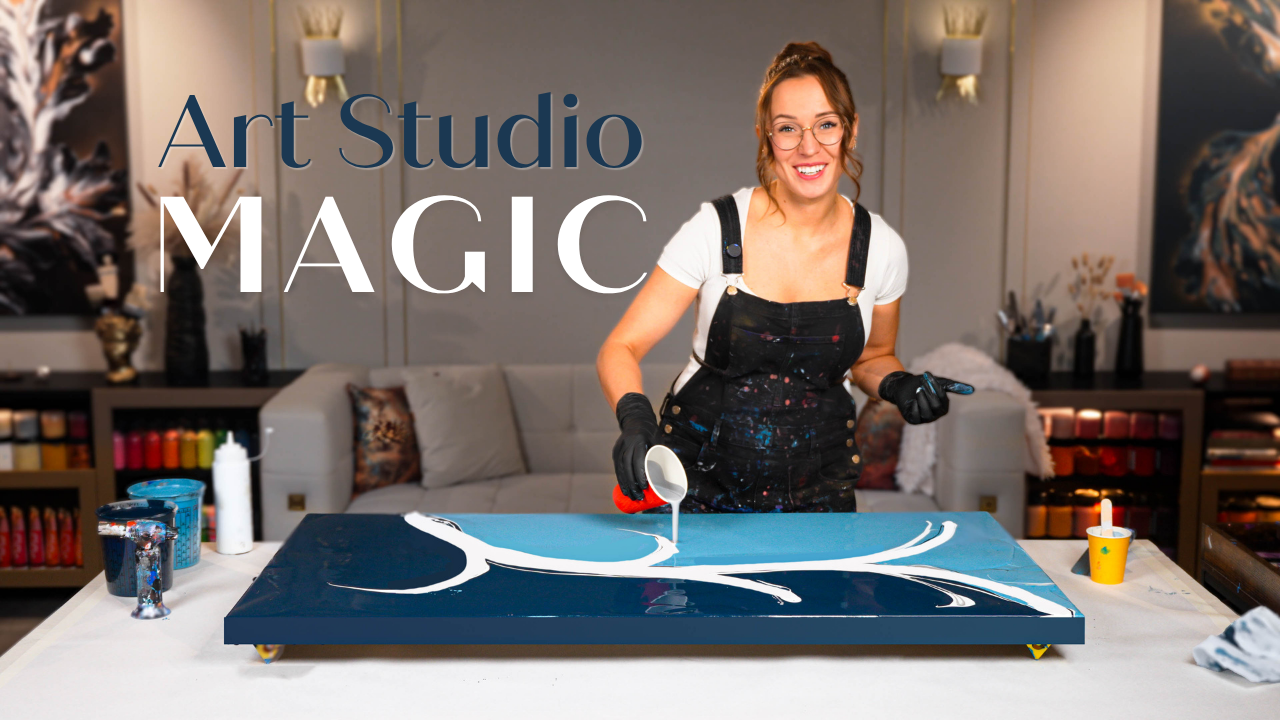
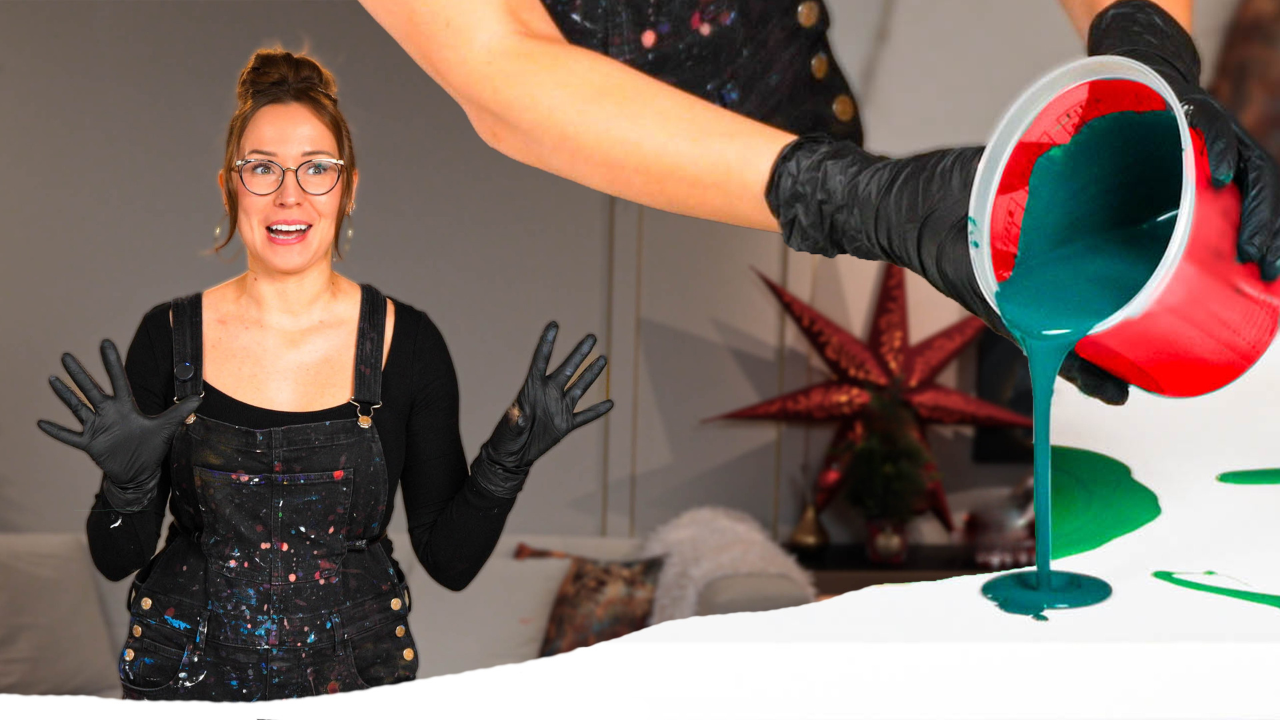
And that's exactly what happened with the painting in the video below.
It was going well. There wasn't necessarily anything obviously "wrong" with it.
But something just wasn't clicking for me.
I kept looking at the flow and knew it wasn't where I wanted it to be. So instead of convincing myself that I should be happy with it simply because the painting was already underway, I made the decision to repour the paint for the flow and start the blowout again from scratch.
And I think this is especially important to remember if you're very critical of your own art.
Struggling with a painting doesn't mean you're failing.
Changing your mind doesn't mean you made a mistake.
Sometimes that's simply what creating looks like.
There isn't one single "right" creative process where every decision works perfectly the first time.
You are allowed to look at your painting and think, "No, this isn't it yet."
You are allowed to experiment with another direction.
You are allowed to scrape something, pour over it, redo a blowout, change a color, or keep working until the painting starts to feel right to you.
That's not the wrong process.
That's the normal creative process.
5. Compare Your Art With YOUR Art
Comparison can be useful.
But choose your comparison carefully.
If you've been learning acrylic pouring for six months and you're comparing yourself with an artist who has spent ten years refining their fluid art techniques, you're comparing two completely different chapters.
Instead, occasionally pull out one of your paintings from a few months ago.
Look at your color choices.
Your control of the flow.
Your confidence.
Your finishing details.
We experience our artistic growth so gradually that it's surprisingly easy not to notice it.
Looking backward once in a while lets you see how far you've actually traveled.
6. Turn Self-Criticism Into Positive Leverage
This might be the most important shift I've made.
When something about your art consistently bothers you, don't automatically treat that feeling as an insecurity you need to overcome.
Sometimes it's telling you exactly what you need to learn next.
Several years ago, I was deeply frustrated with the technical side of my fluid paintings.
My cell reactions could be inconsistent and unpredictable.
I'd regularly experience cracking or crazing.
Sometimes my colors would dry so dull that I'd come back the next day and barely recognize the painting I had been so excited about while it was wet.
And yes, I was critical of those results.
But eventually that frustration became leverage.
Instead of simply thinking, "Why can't I get this right?" I started asking:
Why is this happening?
I experimented.
I studied materials.
I tested different ratios and products.
I paid much closer attention to paint consistency, layering, and the science behind fluid paint.
Little by little, the process became less unpredictable.
And all of that experimentation eventually became the foundation of the recipe and system I now teach inside my Fluid Art Mastery course.
Something that once frustrated me enormously ultimately pushed me to become a much stronger fluid artist - and later allowed me to help other artists avoid many of the same struggles.
I can't believe how many messages and comments like this I receive:
"Your courses and in particular your recipe and method helped level up my art."
"Thanks to your excellent instructions and magic Soby recipe. I feel like the sky is the limit now."
"What an amazing difference your recipe has made for me! I did 3 paintings yesterday; they are all vibrant with color, and the compositions were so much easier than I had ever done before."
And that's exactly my point.
None of this would have happened if I had simply accepted the inconsistent results I was getting and told myself, "Well, that's just how fluid art is."
I was dissatisfied. I was critical. But instead of allowing that criticism to convince me I wasn't good enough, I used it as a reason to dig deeper.
That's what I mean by using your inner critic as positive leverage.
If your acrylic pouring results are inconsistent, perhaps it's time to understand why rather than hoping the next pour behaves differently.
Don't let dissatisfaction simply tell you:
"You're not good enough."
Make it answer a much more useful question:
"What is this showing me that I need to learn?"
Then go learn it.
7. Remember Why You Started Making Art
We can become so focused on getting better that we forget we're supposed to enjoy this.
I love improving my art.
I love challenging myself.
I love looking at a painting and thinking, "I can make this better."
But I also simply love paint.
I love color.
I love watching fluid acrylics move across a canvas.
I love that moment when an idea that existed only in my imagination begins appearing in front of me.
Improvement and joy don't have to compete with each other.
You can take your artistic growth seriously without treating every painting like an examination you have to pass.
You Don't Need to Lower Your Standards
If you're your own worst critic, I'm not going to tell you to suddenly love everything you create.
I don't.
And I don't think that's necessary.
Having high standards can be a tremendous advantage as an artist.
They can push you to understand your materials, improve your fluid art techniques, create stronger, more intentional fluid paintings, and gradually develop an artistic style that feels genuinely your own.
The goal isn't to lower those standards.
It's to make them work for you instead of against you.
So don't necessarily silence your inner critic.
Train it.
Make it specific.
Make it curious.
Make it notice what's beautiful too.
And when it identifies something that genuinely needs improvement, use that dissatisfaction as fuel to learn, experiment, and move forward.
Then get back to creating and, most importantly, have fun!
Colorfully yours,
Olga Soby
Struggling with paint that’s too runny, too thick, or just not giving you the reaction you want?
You’re not alone — consistency is the #1 challenge I see for fluid artists. That’s exactly why I put together my free Consistency Cheat Sheet. It’s a quick and practical guide that shows you how to mix your paints for different techniques, so you can finally pour with confidence and get results you love.